
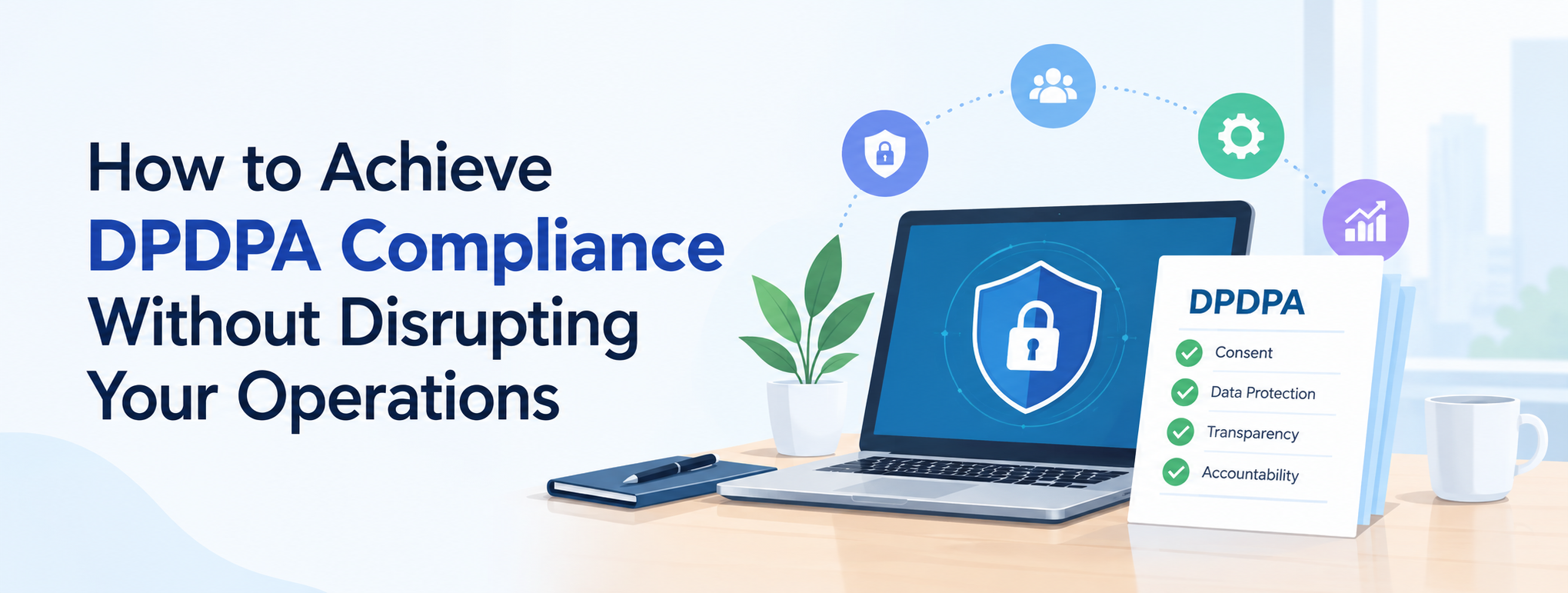
How to Achieve DPDPA Compliance Without Disrupting Your Operations
Struggling with DPDPA compliance? Get a practical, step-by-step DPDPA implementation guide to protect data without slowing down your business. Read now.
Introduction
Every business in India that collects, stores, or processes personal data is now staring at a deadline that cannot be ignored. DPDPA compliance is no longer a "future problem", the Digital Personal Data Protection Act compliance clock is running, and regulators expect organizations to be ready.
The catch? Most companies assume that becoming compliant means slowing down operations, freezing product launches, or spending months rebuilding IT systems from scratch. That fear is understandable, but it's also misplaced. With the right DPDPA compliance framework, businesses in Bangalore and across India can meet every legal requirement while keeping daily operations running smoothly.
This guide breaks down exactly how to comply with DPDPA in a structured, low-disruption way, whether you run an IT/SaaS company, a manufacturing plant, a BFSI firm, a healthcare organization, a renewable energy business, a university, or an AI/ML startup. By the end, you'll have a practical DPDPA compliance checklist you can start using today.
What Is DPDPA Compliance?
DPDPA compliance means aligning your organization's data collection, storage, processing, and sharing practices with the Digital Personal Data Protection Act, 2023, India's primary data privacy law. The Act governs how businesses (called "Data Fiduciaries") handle the personal data of individuals ("Data Principals"), and it applies to nearly every sector that touches customer or employee data.
In simple terms, DPDPA compliance requires businesses to:
- Collect only the personal data they genuinely need
- Get clear, informed consent before processing that data
- Protect the data with reasonable security safeguards
- Allow individuals to access, correct, or withdraw consent for their data
- Report data breaches to the Data Protection Board within a set timeframe
Non-compliance isn't a minor risk. Penalties under the Act can run into hundreds of crores of rupees depending on the nature and scale of the violation, making DPDPA data protection a board-level priority, not just an IT task.
Why DPDPA Compliance Matters for Every Industry
A common misconception is that DPDPA obligations for businesses only apply to tech companies. In reality, the Act touches almost every sector:
- IT & SaaS companies handle customer data across cloud environments, often with third-party vendors and cross-border data flows.
- BFSI companies process highly sensitive financial and identity data, making them prime regulatory targets.
- Healthcare organizations manage patient records that require the strictest safeguards.
- Manufacturing companies collect employee, vendor, and supply-chain data that's often overlooked in compliance planning.
- Renewable energy companies increasingly rely on IoT and SCADA systems that gather operational and personal data simultaneously.
- Universities & research institutions hold student, staff, and research participant data across long retention periods.
- AI/ML startups train models on datasets that may contain personal information, raising unique consent and purpose-limitation challenges.
Whatever industry you're in, DPDPA compliance requirements apply the moment you collect a name, email address, phone number, or any identifiable information, which is why a structured DPDPA compliance strategy matters for medium enterprises and large corporations alike.
The Real Reason Businesses Fear DPDPA Implementation
Ask any operations leader why they've delayed DPDPA compliance in India, and the answer is almost always the same: fear of disruption. Common concerns include:
- Rewriting IT infrastructure from scratch
- Halting customer onboarding while consent systems are rebuilt
- Retraining entire teams overnight
- Losing productivity during audits and documentation drives
These fears are valid, if compliance is treated as a one-time emergency project. But when approached as a phased DPDPA compliance process, most of this disruption is avoidable. The key is sequencing the work correctly and using the right technical partners to implement changes in the background, without touching your core operations.
Step-by-Step DPDPA Implementation Guide
Step 1: Conduct a DPDPA Readiness Assessment
You can't fix what you haven't measured. A DPDPA readiness assessment maps out:
- What personal data you currently collect
- Where it's stored (cloud, on-premise, third-party vendors)
- Who has access to it internally and externally
- Existing consent mechanisms and gaps
- Current data retention and deletion practices
This assessment typically takes one to two weeks for mid-sized businesses and forms the foundation of your entire DPDPA compliance framework. Skipping this step is the single biggest reason companies over-engineer their compliance projects later.
Step 2: Build a Data Inventory and Classification System
Once you know what data exists, classify it by sensitivity, financial data, health records, biometric data, and children's data typically require stricter controls than general contact details. This classification lets you apply proportionate safeguards instead of applying maximum security everywhere, which is where most of the "disruption" fear actually comes from.
Step 3: Update Consent Mechanisms
Under the Act, consent must be free, specific, informed, unconditional, and unambiguous. Practical steps include:
- Rewriting privacy notices in clear, simple language
- Adding granular consent toggles (not blanket "accept all" boxes)
- Building a consent withdrawal mechanism that's as easy as giving consent
- Logging consent timestamps for audit purposes
Most consent management updates can be layered onto existing websites and apps using APIs, meaning no downtime is required.
Step 4: Appoint a Data Protection Officer or Point of Contact
Significant Data Fiduciaries are required to appoint a Data Protection Officer (DPO). Even businesses not classified as "significant" benefit from designating an internal point of contact who understands DPDPA compliance requirements and can liaise with regulators, customers, and internal teams.
Step 5: Strengthen Technical and Organizational Safeguards
This is where a DPDPA compliance solutions partner adds the most value. Typical safeguards include:
- Data encryption at rest and in transit
- Role-based access controls
- Regular vulnerability assessments and penetration testing
- Automated data backup and disaster recovery systems
- Breach detection and incident response protocols
Because these safeguards are largely infrastructure-level, they can be implemented in parallel with daily business operations, especially when managed by an experienced IT and cybersecurity partner.
Step 6: Draft Internal Policies and Train Employees
Documentation matters as much as technology under the Act. Businesses need:
- A data protection policy
- A breach response plan
- A data retention and deletion schedule
- Employee training records
Short, role-specific training sessions (30–45 minutes per department) are far more effective, and far less disruptive, than company-wide, day-long compliance workshops.
Step 7: Set Up Continuous Monitoring
DPDPA compliance isn't a one-time certificate; it's an ongoing discipline. Quarterly internal audits, automated compliance dashboards, and periodic third-party reviews keep your organization audit-ready year-round instead of scrambling before a deadline.
DPDPA Compliance Checklist
Use this quick-reference checklist to track progress:
- Completed a DPDPA readiness assessment
- Built a data inventory and classification system
- Updated privacy notices and consent flows
- Appointed a DPO or internal privacy lead
- Implemented encryption and access controls
- Set up breach detection and response protocols
- Documented internal data protection policies
- Trained employees by department
- Scheduled quarterly compliance audits
How to Comply With DPDPA Without Disrupting Operations
The businesses that implement DPDPA compliance smoothly share three habits:
- They phase the rollout. Instead of a single "big bang" project, they break implementation into 30-60-90 day milestones.
- They automate wherever possible. Consent logging, data mapping, and breach alerts are automated rather than manually tracked in spreadsheets.
- They bring in specialists for infrastructure changes. Encryption, backup systems, and access controls are handled by experienced IT partners working in the background, so internal teams keep focusing on core business functions.
Think of it like renovating a building while people still work inside it, it's entirely possible when the work is sequenced correctly and handled by people who've done it before.
Why is Gigahertz Consultants the Right Partner for DPDPA Compliance?
Gigahertz Consultants brings hands-on experience across cloud infrastructure, cybersecurity, data backup, and IT consultancy for businesses in Bangalore and beyond. This combination matters because DPDPA compliance isn't just a legal checklist, it's fundamentally a data infrastructure challenge.
Here's why that matters for your DPDPA compliance strategy:
- Cybersecurity expertise ensures the technical safeguards required under the Act, encryption, access control, breach detection, are implemented correctly the first time.
- Data backup and disaster recovery capabilities directly support the Act's requirements around data integrity and breach response.
- Cloud infrastructure experience means compliance can be built into your existing systems rather than forcing a costly migration.
- IT consultancy background allows Gigahertz Consultants to design a phased DPDPA implementation guide tailored to your industry, whether you're a BFSI firm managing sensitive financial data or a healthcare provider safeguarding patient records.
Rather than treating compliance as an isolated legal exercise, Gigahertz Consultants integrates it into your broader IT and cybersecurity posture, which is exactly how disruption is avoided.
Talk to Gigahertz Consultants about a DPDPA readiness assessment for your business.
Frequently Asked Questions
1. What is DPDPA compliance? DPDPA compliance means aligning your business's data collection, storage, and processing practices with India's Digital Personal Data Protection Act, 2023, including obtaining valid consent, securing personal data, and honoring individual data rights.
2. Who needs to comply with DPDPA? Any organization that collects or processes personal data of individuals in India, including IT companies, BFSI firms, healthcare providers, manufacturers, universities, and startups, must comply, regardless of company size.
3. How long does DPDPA implementation typically take? For most medium and large enterprises, a phased DPDPA implementation guide spans 60–120 days, starting with a readiness assessment and moving through consent updates, technical safeguards, and employee training.
4. What happens if a business doesn't comply with DPDPA? Non-compliance can result in significant financial penalties determined by the Data Protection Board of India, along with reputational damage and loss of customer trust.
5. Does DPDPA compliance require a complete IT overhaul? No. Most DPDPA compliance requirements can be layered onto existing systems through updated consent flows, access controls, and encryption, without replacing core infrastructure.
6. How can a business start its DPDPA compliance journey? The first step is a DPDPA readiness assessment to map existing data practices, followed by building a data inventory, updating consent mechanisms, and strengthening technical safeguards with an experienced IT and cybersecurity partner.
Conclusion
DPDPA compliance doesn't have to mean choosing between legal safety and business continuity. With a phased DPDPA compliance framework, starting with a readiness assessment, followed by consent updates, technical safeguards, and continuous monitoring, businesses across IT, BFSI, healthcare, manufacturing, renewable energy, and education can meet every requirement of the Digital Personal Data Protection Act without missing a beat operationally.
The businesses that get this right don't treat compliance as a one-time scramble. They build it into their existing IT and cybersecurity foundation, one phase at a time.
If your business is ready to start its DPDPA compliance journey without operational disruption, connect with Gigahertz Consultants for a tailored readiness assessment and implementation roadmap.
Category: SCADA